Sprocket Analysis & Redesign
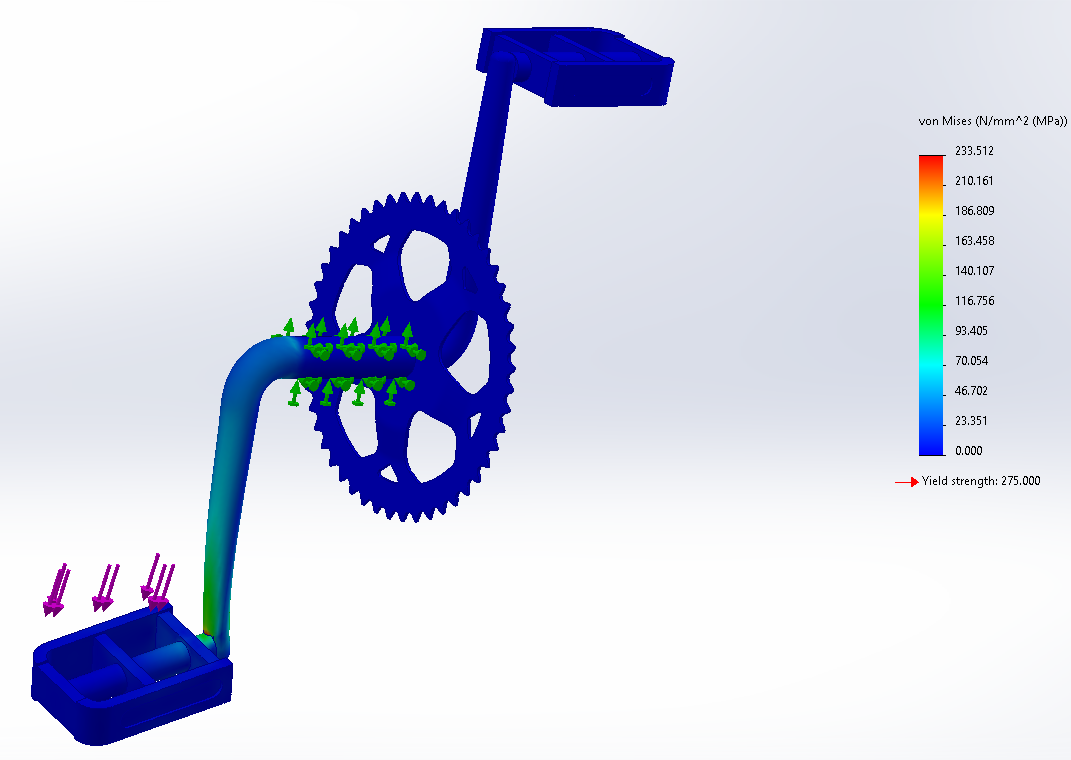
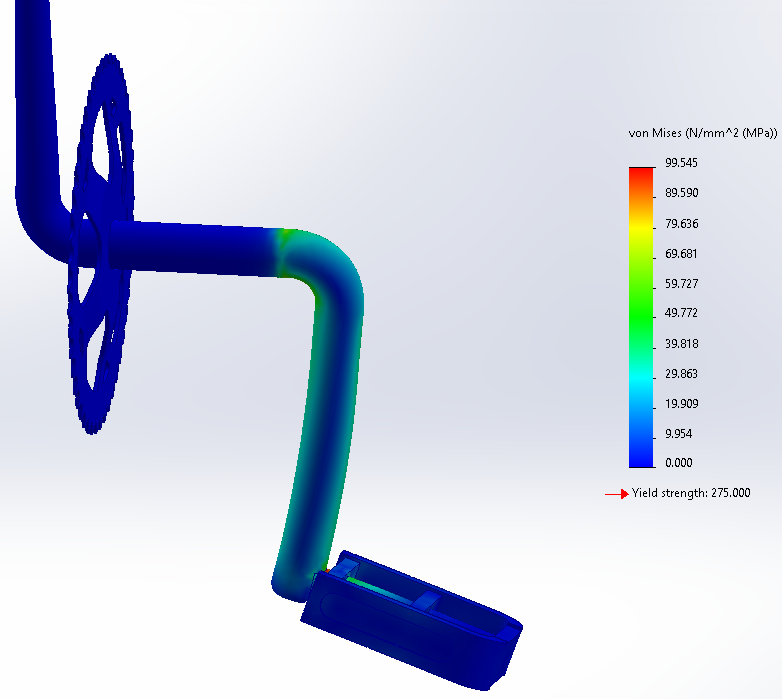
The initial pedal and sprocket assembly was tested under the maximum expected pedaling force. The first iteration showed high von Mises stresses near the linkages, resulting in a low factor of safety of 1.2. To resolve this, the geometry was adjusted by thickening the critical load-bearing areas. A second static analysis confirmed the stress was significantly reduced, bringing the overall factor of safety up to 2.7.
Full Frame & Fork Assembly Analysis
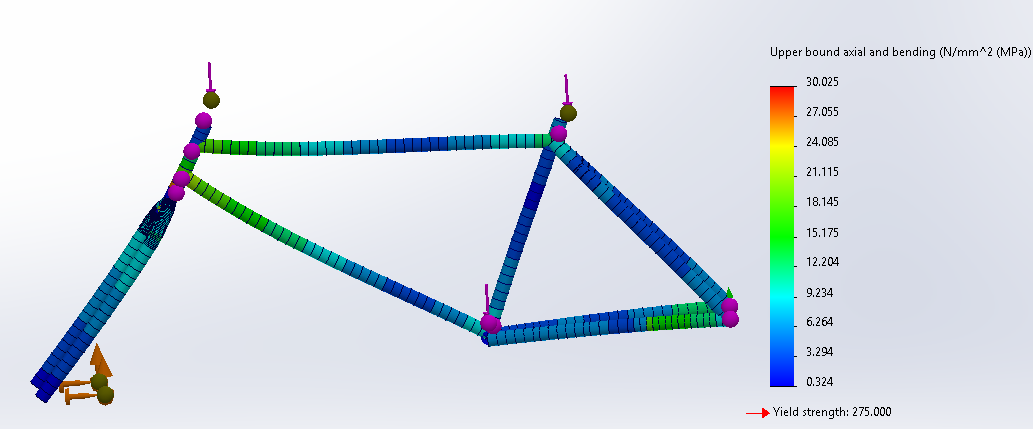
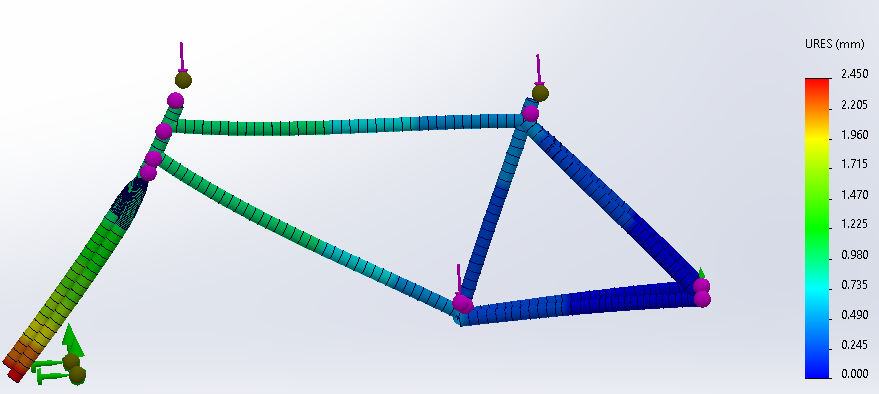
The frame and fork assembly was evaluated as a single unit using 3D beam elements under a distributed load (140 lbf at the saddle, 40 lbf at the handlebars, and 20 lbf at the pedals). The static beam analysis showed a maximum axial and bending stress of 30.025 MPa and a minimal displacement of 2.45 mm, yielding a durable minimum FOS of 9.15. Additionally, a dedicated buckling analysis on the front fork resulted in a critical buckling load factor (BLF) of 153.56, indicating it can easily withstand compressive failure.
Manual vs. FEA Results
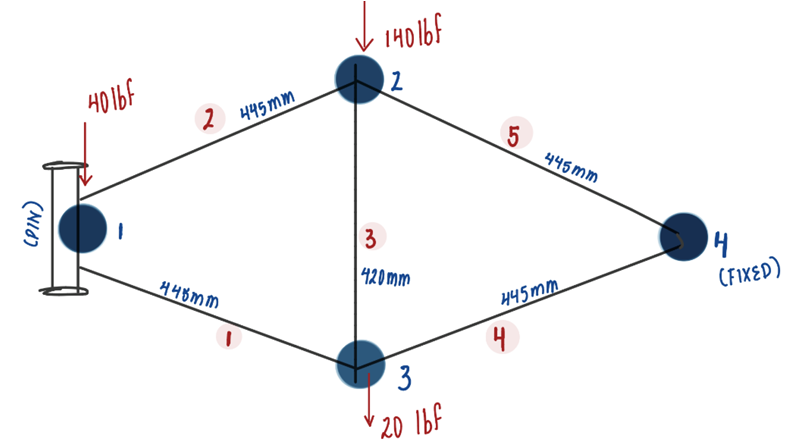
To verify the SolidWorks Simulation results, a 5-element 2D truss model of the frame was set up and solved manually using MATLAB. Because a 2D truss assumes simple pin joints, while the 3D SolidWorks model assumes rigid, welded joints, some variance was expected. However, Element 2 showed an axial force of 402.21 N for the simulated results and 398.18 N for manual calculations, resulting in a 1.0% error. Element 5 yielded an 8.9% error, proving that the boundary conditions and applied loads were set up correctly.